




Here’s the Arm You Should Get Your COVID Shot In, New Study Finds

Updated: Dec. 03, 2023





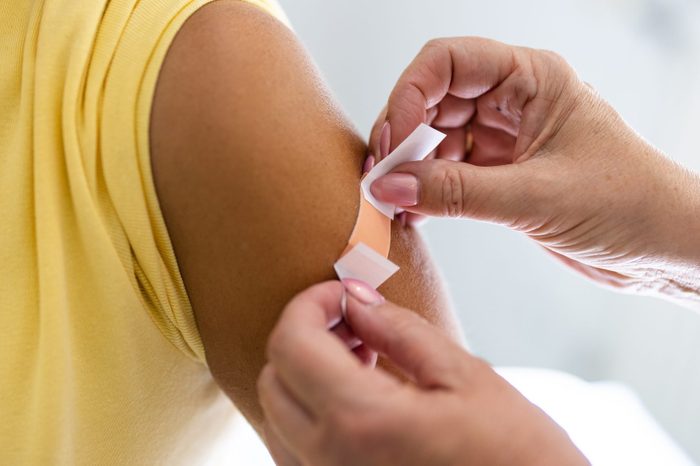
Researchers in Germany found that your COVID-19 vaccine might act stronger if you roll up this sleeve instead of the other.
As of August 2023, the World Health Organization has reported that nearly 13.5 billion COVID-19 vaccine doses have been administered across the globe. Considering this figure, an August 2023 study published in the peer-reviewed Lancet journal, eBioMedicine, explores a curiously overlooked area of vaccine research: The scientists examined whether the second dose of an individual’s COVID-19 vaccine should be administered on the same side as the first (ipsilateral), or the opposite side (contralateral) from the first.
Laura Ziegler, a doctoral immunology student at Germany’s Saarland University, sums it up: “Our study indicates that ipsilateral vaccinations generate a stronger immune response than contralateral vaccinations.” In other words, getting both shots on the same side might be to your advantage. Here’s how.
The COVID vaccine: which arm? Scientific research revealed the answer
Researchers, including Ziegler and Martina Sester, PhD, Chair of the Department of Transplant and Infection Immunology at Saarland University, observed 303 previously unvaccinated individuals. Half of these individuals (147) received the second dose of the BioNTech COVID-19 vaccine on the same side as the first dose, while the other half (156) received it on the opposite side.
Two weeks after the second dose, scientists tested for specific antibodies and T-cell responses linked to the vaccine’s efficacy.
Both groups demonstrated robust antibody responses. “The number of antibodies, however, was not greater,” says Dr. Sester. Yet, there was a distinct quality to the antibodies produced: “What’s interesting is that the antibodies in the ipsilaterally vaccinated subjects were better at binding to the viral spike protein,” explains Dr. Sester. However, those who received their second dose on the opposite side exhibited lower neutralizing activity against the virus, a critical component of immunity.
There’s another set of defenders called T-cells that your body uses for long-term protection. The study showed some interesting findings about them. Individuals who received the second dose on the opposite arm had significantly lower levels of spike-specific CD8 T-cells, a type of “killer” cell essential for destroying infected cells. On the other hand, while CD4 T-cell levels were consistent across both groups, participants who received the second dose on the opposite arm showed higher CTLA-4 expression, a molecule linked to the regulation of T-cell activity.
The science suggests that while both methods induce a potent immune response, secondary boosting is more pronounced when the vaccine is administered in such a manner that allows the same lymph nodes used for the initial dose to also handle the second dose. This results in higher neutralizing antibody activity and more substantial CD8 T-cell responses.
So, in conclusion: For the average individual, a stronger immune response might lead to better protection against infection and severe disease, giving a slight edge to receiving both doses on the same side.
The Covid Booster and Flu Shot: Can You Get Both at Once? Doctors’ Advice
What this means for you
“As dramatic as the pandemic was, it has provided us with reliable data that enables us to address questions of this kind,” explains Dr. Sester. Understanding the nuances of vaccine administration becomes crucial as the world continues to adapt and evolve its strategies against COVID-19. While this study focuses on a specific aspect of vaccination, it sheds light on the importance of continual research and optimization.
For now, if you’re gearing up for your second dose, you might consider keeping it on the same side. If it seems tricky to remember which arm you received the first in, a general rule of thumb is that some clinicians administering vaccines will suggest your non-dominant hand to avoid interfering with your daily tasks as much as possible…a clever reminder to be armed with.
For more wellness updates, subscribe to The Healthy @Reader’s Digest newsletter and follow The Healthy on Facebook and Instagram. Keep reading:
Originally Published: September 07, 2023

